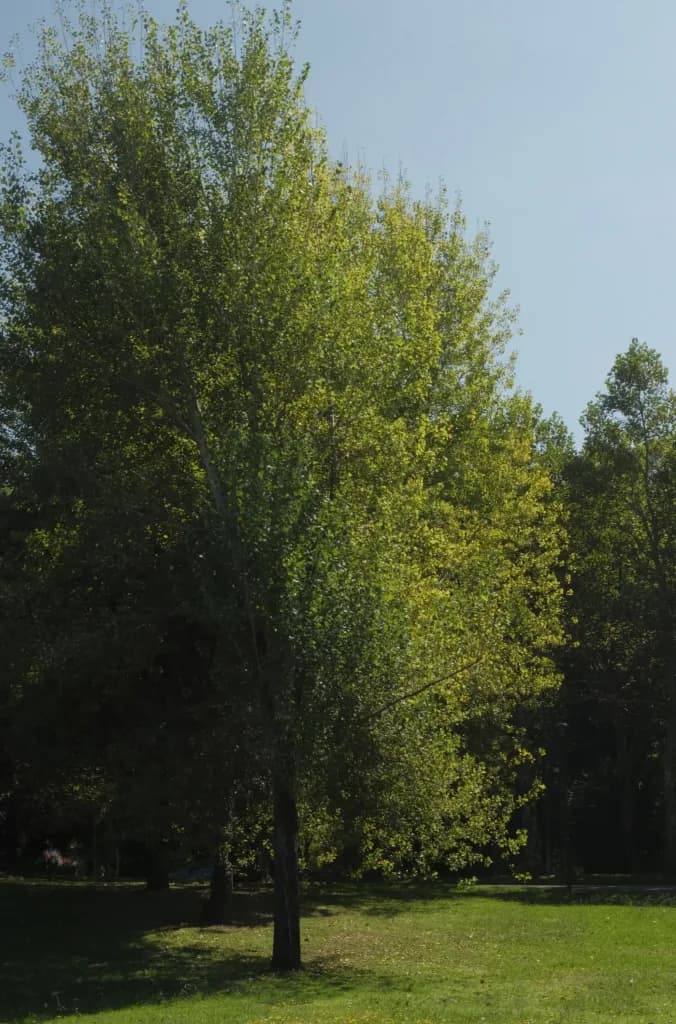
Populus nigra
The black poplar is a large deciduous tree, appreciated for its rapid growth and imposing vertical habit. Its silhouette is usually broad and branched, although columnar varieties are very common in urban landscapes. It has deltoid or rhomboidal leaves, a deep green color that turns bright yellow during autumn, creating a notable visual spectacle before the winter drop. Its bark, grayish and smooth in youth, becomes dark and deeply fissured with age.
Botanically, it belongs to the Salicaceae family and is native to riparian ecosystems, growing naturally near rivers, lakes, and areas with high water tables. It is a dioecious species, meaning there are separate male and female specimens; the former produce reddish catkins and the latter release a characteristic white 'fluff' (pappus) that carries seeds through the wind during spring.
In cultivation, it is frequently used in rows to create windbreaks or to provide quick shade in large parks and gardens. Its wood is soft and light, historically used in the manufacture of packaging, paper pulp, and cheap carpentry. A fascinating fact is that its bark contains salicin, a substance with analgesic properties that was fundamental to the development of modern aspirin, underscoring its importance not only ecologically but also medicinally.
Very frequent, requires moist soils, water 3 times a week in summer.
Full sun, requires direct exposure for optimal and healthy growth.
Very resistant, tolerates intense frosts down to -20°C and hot climates.
Deep, fertile, and with good moisture retention, preferably clayey.
Organic matter input like compost in spring to promote growth.
Have this plant? Analyze it free with Florami
Free AI analysis
