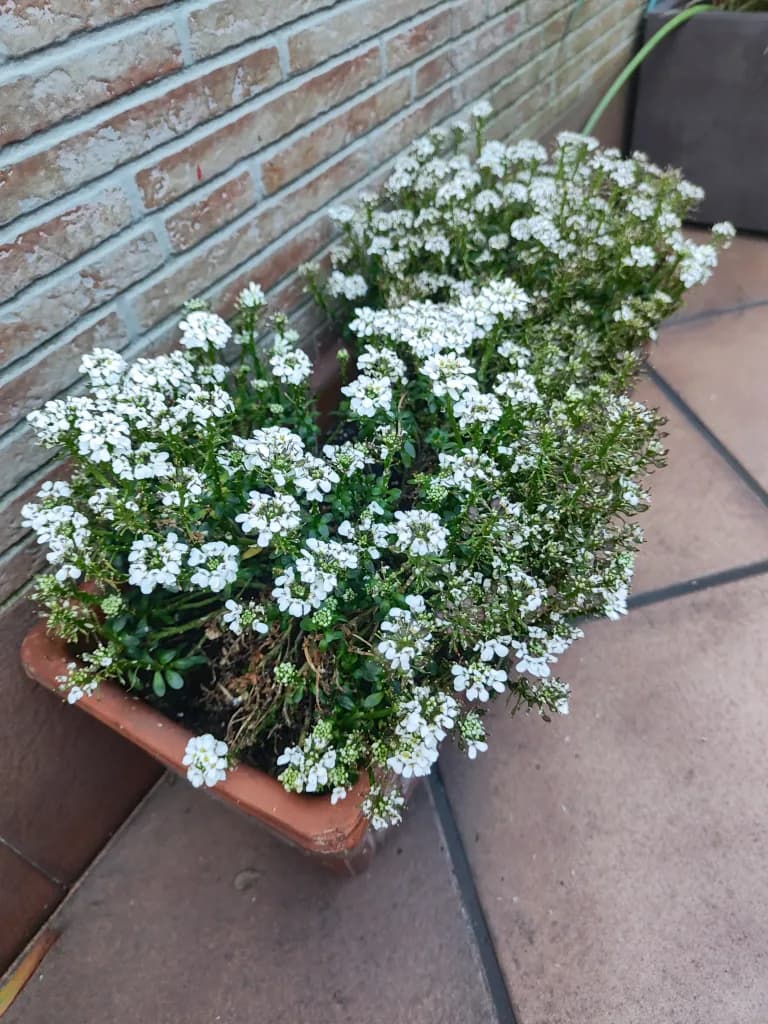
Iberis sempervirens
White Candytuft is a low-growing perennial plant highly valued in gardening for its dense and luminous white flowering. Its small, four-petaled flowers cluster in terminal racemes that almost completely cover the dark green, persistent foliage during spring. It is an excellent choice for rock gardens, borders, or as a groundcover in pots, offering a very decorative "white cloud" appearance that attracts numerous pollinators.
It belongs to the Brassicaceae family and originates from the Mediterranean basin. It is characterized by its creeping and branching growth, forming compact mounds that barely exceed 25-30 centimeters in height. Its leaves are narrow, leathery, and a deep green color that is maintained year-round, justifying its specific epithet "sempervirens" (always green), thus maintaining visual interest even outside the flowering season.
Its cultivation is simple due to its great hardiness and resistance to both intense cold and moderate drought once established. It prefers sunny exposures and soils with very good drainage to avoid root rot, its main enemy. Maintenance pruning just after the flowers have faded is key to maintaining its rounded shape and preventing the center of the plant from degrading and losing foliage.
Moderate, twice weekly; let substrate surface dry between waterings.
Full sun, minimum 6 hours of direct light daily.
Very hardy, tolerates frosts down to -15°C and summer heat.
Well-drained, preferably calcareous or neutral; avoid heavy clays.
Balanced liquid fertilizer every 20 days in spring and summer.
Examples shared by the community when the plant was in bloom
Have this plant? Analyze it free with Florami
Free AI analysis
