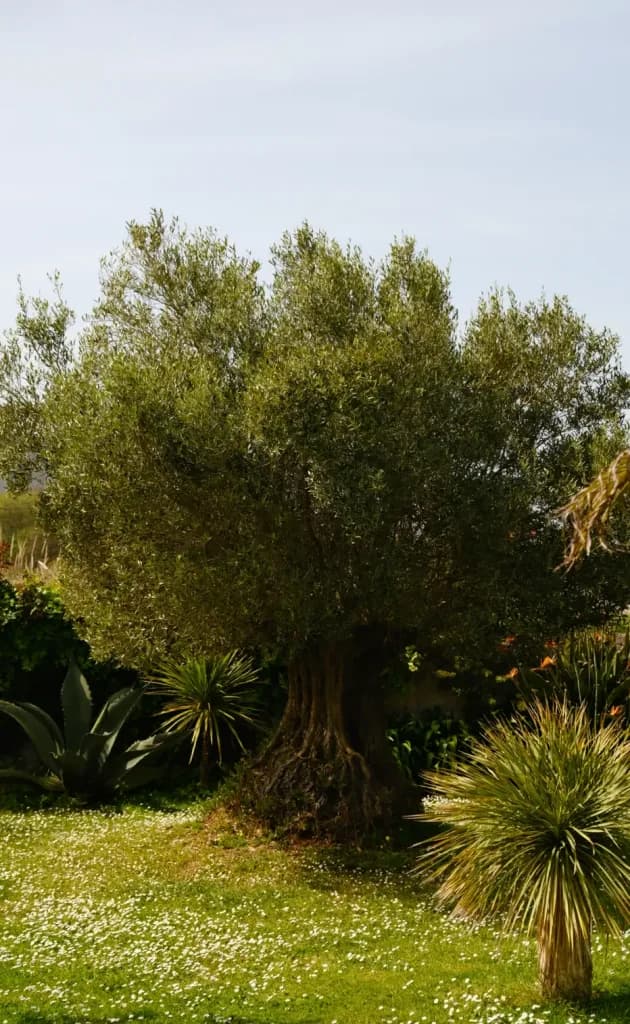
Olea europaea
The common olive tree is a perennial evergreen emblematic of Mediterranean culture, recognized for its thick, gnarled, and often hollow trunk that acquires sculptural shapes with maturity. Its leaves are small, leathery, and lanceolate, with a characteristic grayish-green color on the upper surface and a bright silvery hue on the underside. This species is widely appreciated both for its aesthetic value in landscaping and for its enormous economic importance in the global production of olive oil and table olives.
Botanically, it belongs to the Oleaceae family and originates from the regions surrounding the Mediterranean Sea, as well as from parts of the Middle East and Africa. It is an extremely hardy and resilient plant, adapted to survive in poor, calcareous soils and under severe arid conditions. It possesses a very extensive and powerful root system that allows it to anchor firmly to the ground and extract moisture from deep layers, making it a natural survivor of warm climates.
Its cultivation dates back to classical antiquity, being a universal symbol of peace, glory, and wisdom in various civilizations. In the home garden, it is an excellent choice for xeriscaping due to its very low water requirement once established. The longevity of these trees is legendary, with thousand-year-old specimens still producing fruit today. Its maintenance is simple, mainly requiring formative pruning and a location that guarantees maximum possible sun exposure throughout the year.
Scarce, tolerates drought; once a week in summer, none in winter.
Full direct sun, minimum 6 to 8 hours of exposure daily.
Temperate climate; withstands frosts down to -10°C and extreme heat above 40°C.
Very well-drained, prefers calcareous, stony soils with little organic matter.
Moderate organic or nitrogen fertilizer application only in spring and autumn.

The olive tree is an extremely long-lived tree that can live for thousands of years; the greatest danger to its health is excessive water at the roots.
Have this plant? Analyze it free with Florami
Free AI analysis
