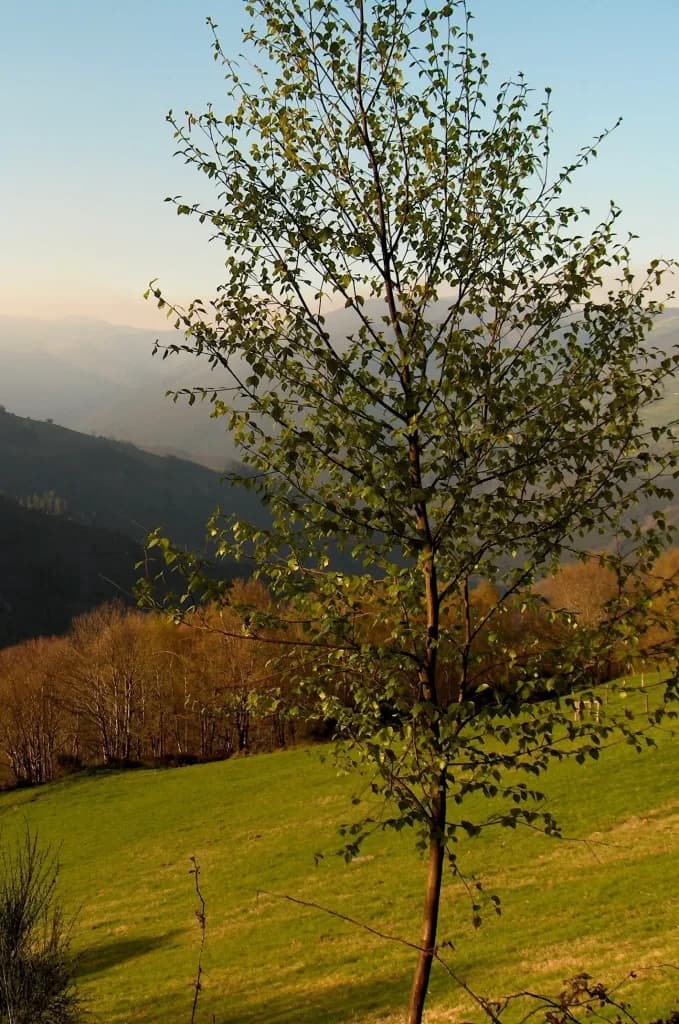
Betula pendula
The silver birch is an elegant, light-crowned deciduous tree, highly valued for its characteristic bark which, although brownish in young specimens like the one pictured, turns a bright silvery white with maturity. Its leaves are small, rhomboidal or triangular in shape with markedly serrated edges, and hang from thin, flexible branches that move with the slightest breeze. During autumn, its foliage transforms into a visual spectacle of intense yellow tones before falling.
It belongs to the Betulaceae family and is native to a vast region stretching from Europe to Siberia. In its natural habitat, it is usually found in mountain areas, riverbanks, and clearings in temperate forests. It is a pioneer species, meaning it is one of the first trees to colonize open land after fires or logging, thanks to its ability to grow rapidly on poor soils as long as sufficient moisture is available.
In landscaping, it is frequently used in groups or as a specimen in large gardens due to its high ornamental value. In addition to its beauty, the birch has a long history of traditional uses: its wood is valued in cabinetmaking, its sap is extracted in spring to make syrups or fermented drinks in Northern Europe, and its bark has been historically used to make everything from footwear to waterproof containers.
Frequent in summer, keep substrate moist without waterlogging.
Full sun or partial shade; needs plenty of light for optimal development.
Temperate or cold climates, tolerates frost but suffers in extreme heat.
Acidic to neutral soils, rich in organic matter and retentive.
Organic in spring and autumn (compost or worm castings).
Have this plant? Analyze it free with Florami
Free AI analysis
