Agave americana
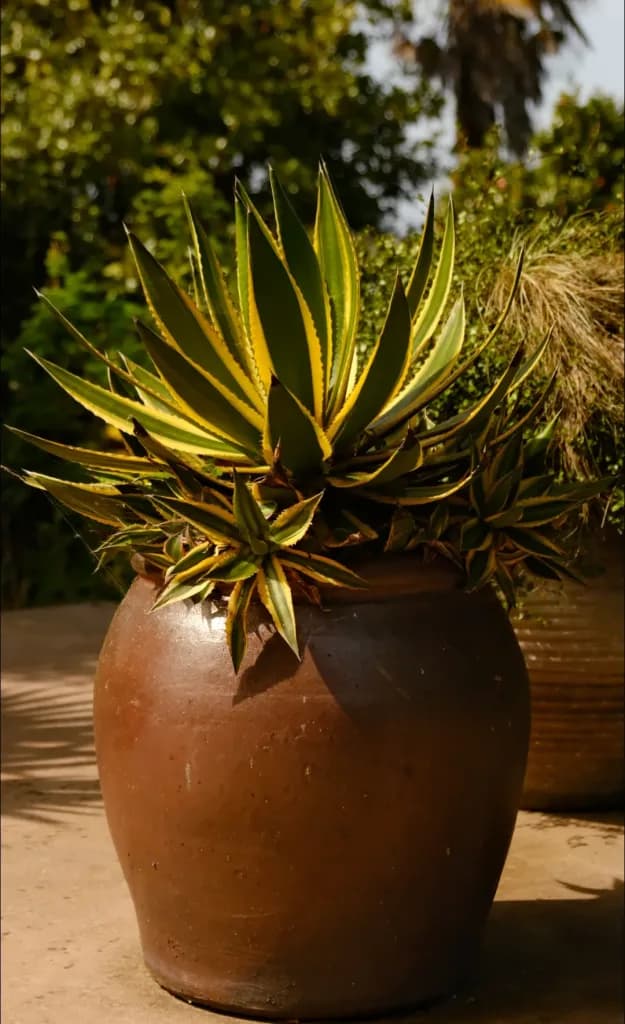
The agave amarillo is a large, perennial succulent plant, highly valued in landscaping for its striking rosette of fleshy leaves. Its leaves are rigid and end in a thorny point, characterized by a grayish-green color in the center with wide, vibrant yellow margins. This variegated variety brings exceptional architectural brightness to low-water gardens and large pots.
Botanically, it belongs to the Asparagaceae family and is native to the arid and semi-arid regions of North America, especially Mexico. It is a species adapted to extreme conditions of drought and intense heat, storing water in its thick leaf fibers. Its edges have small, curved teeth that act as natural defense, so it should be placed away from frequently used areas to avoid accidental punctures.
In home cultivation, it is one of the most resistant and easy-to-maintain succulents, ideal for beginners. A fascinating characteristic is its monocarpic nature: the plant lives for many years accumulating energy until it produces a single, immense flower stalk that can reach several meters in height. After this spectacular flowering, the mother plant dies, but it usually leaves numerous basal shoots that ensure the continuity of the species.
Scarce, every 15-20 days in summer, none in winter. Allow soil to dry out.
Full direct sun, minimum 6 hours daily to maintain color.
Warm climates; tolerates light occasional frost down to -5°C.
Very well-draining, cactus mix with silica sand or pumice.
Optional, very diluted succulent fertilizer once in spring.
Several basal "pups" or shoots are observed in the pot; you can separate them with roots to obtain new plants.
Have this plant? Analyze it free with Florami
Free AI analysis